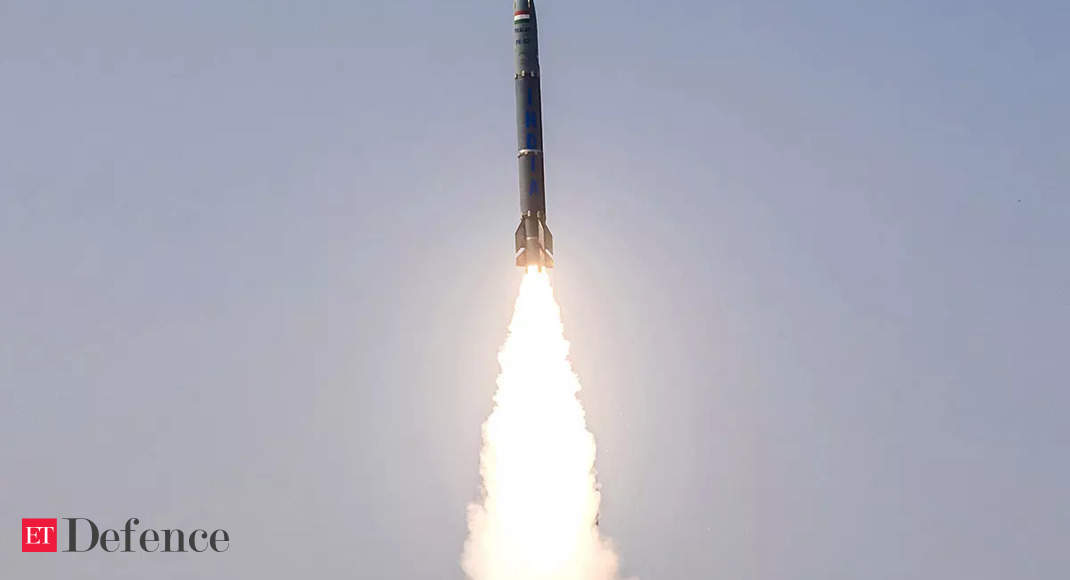
Pralay (lit. 'Apocalypse') is a canisterised surface-to-surface, short-range ballistic missile (SRBM) for battlefield use developed by the Defence Research and Development Organisation (DRDO) of India. The missile is an amalgamation of technologies developed for exoatmospheric interceptor missile Prithvi Defence Vehicle (PDV) and the Prahaar tactical missile. The project to develop Pralay was sanctioned in March 2015 with a budget of ₹332.88 crore (equivalent to ₹502 crore or US$59 million in 2023).
Development
Research Centre Imarat (RCI) is the lead integrator of this project. Pralay belongs to the same class as Dongfeng 12 (CSS-X-15), Precision Strike Missile, 9K720 Iskander and Hyunmoo 2. Powered by a solid fuel rocket motor, the missile reportedly flies a quasi-ballistic trajectory with the ability to perform terminal maneuvers to hinder anti-ballistic missile (ABM) interceptors.
Time from deployment to launch is reportedly within 10 minutes, while transition time from command to launch is reportedly 60 seconds.
Pralay uses the same composite propellant developed by High Energy Materials Research Laboratory (HEMRL) for Sagarika from K Missile family. The composite propellant is highly efficient and generates more energy compared to propellant used in Agni missile series. The aerodynamic characterization research was conducted at the National Aerospace Laboratories' 1.2m Trisonic Wind Tunnel Facility.
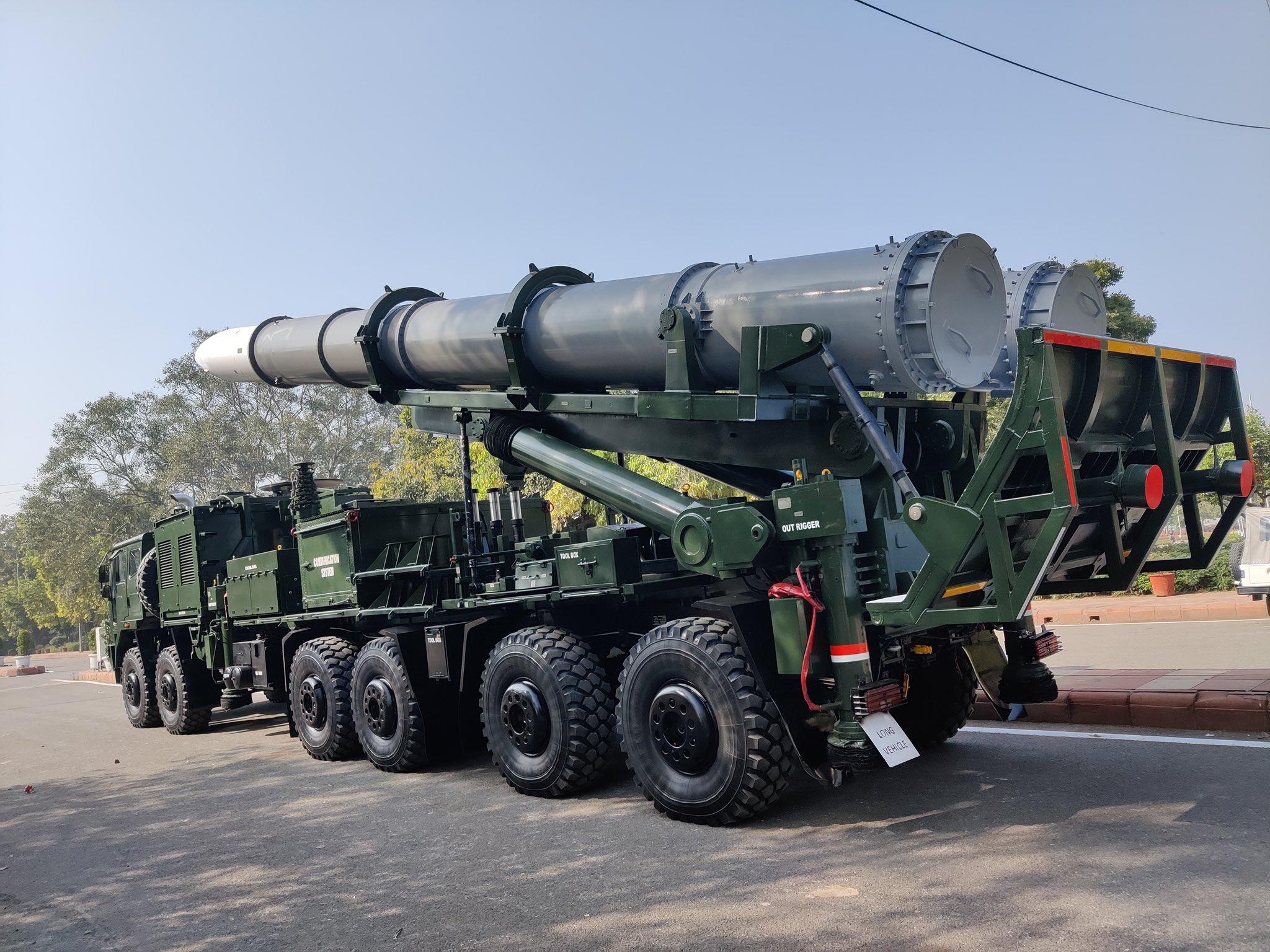
Pralay carries 350-700 kg and 500-1,000 kg high explosive preformed fragmentation warhead, Penetration-Cum-Blast (PCB) and Runway Denial Penetration Submunition (RDPS) at a range of 150 km to 500 km. Pralay is designed to target radar and communication installations, command and control centers and advance airfields using conventional warhead. The system is road mobile and meets the tactical ballistic missile requirement of the Indian Army. Pralay fills the gap of a conventionally armed ballistic missile that is not hampered by 'No First Use' nuclear policy.
Further work is in progress to extend the range by another few hundred kilometers. In 2022, the missile was ready for induction.
Testing
First trial
On 22 December 2021, DRDO conducted the maiden test of Pralay from Abdul Kalam Island. The missile followed quasi ballistic trajectory reaching the designated target at 400 km with high degree of accuracy, validating controls, guidance system and mission algorithms.
Second trial
On 23 December 2021, DRDO conducted another test of Pralay from Abdul Kalam Island. The test was conducted using heavier payload to check the lethality and accuracy of the weapon. Pralay covered the maximum range of 500 km and was monitored by range sensors and instruments, including telemetry, radar and electro-optic tracking system deployed across the eastern coast and the downrange ships positioned near the impact point.
Third trial
DRDO on 7 November 2023 launched Pralay from Abdul Kalam Island. The test was successful and met all the required mission objectives.
Induction
The development phase of Pralay began in 2015 and took four years to test the required technologies. DRDO will conduct four test flights before the missile being commissioned. According to analysts, development of Pralay achieved an important milestone for India's future Rocket Force. In view of 2020–2021 China–India skirmishes, Indian Armed Forces in December 2022 moved proposal for acquisition of Pralay missile. On 25 December 2022, Ministry of Defence (MoD) cleared the order for 120 missiles for the Indian Air Force.
Two more units of 250 Pralay missiles worth ₹7,500 crore are in advance stages of acquisition as of April 2023.
The purchase of a Pralay regiment for the Indian Army was approved by the Ministry of Defence on 17 September 2023. A similar proposal was earlier cleared for the Indian Air Force. The missile will be deployed with conventional warhead for tactical roles along Line of Actual Control (LAC) and Line of Control (LoC).
As of September 2024, the user trials and eventual induction of Pralay missiles are expected soon.
On 26 January 2025, the Pralay twin launcher system based on Ashok Leyland 12×12 high mobility vehicle was featured at the 76th Republic Day Parade. The development of the missile is now over.
Pralay, Nirbhay, BrahMos and Pinaka will become part of the Integrated Rocket Force (IRF), a separate entity from the Strategic Forces Command (SFC).
Operators
India
- Indian Army - 250 on order
- Indian Air Force - 120 on order
- Integrated Rocket Force (planned)
See also
- Shaurya (missile)
- Pragati (missile)
- Pranash (missile)
- Prahaar (missile)
Comparable missiles
- Dongfeng 12 – (China)
- Precision Strike Missile – (United States)
- 9K720 Iskander – (Russia)
- Hyunmoo-2 – (South Korea)
References
External links
Technical:
- DRDO Technology Focus : Warhead for Missiles, Torpedoes and Rockets